
In the global energy transition, Battery Energy Storage Systems (BESS) have become the backbone of grid stability and renewable energy integration. However, a system's performance limit is defined not only by its cell electrochemistry but also by its electrical interconnection technology.
Busbars, copper-aluminum busbars, and grounding jumpers act as the "vascular system" for current transmission and the "safety hub" for the entire system. Studies and field experience show that a significant share of early BESS failures is associated with high contact resistance or mechanical fatigue at connection points. For this reason, prioritizing electrical interconnection as a core part of reliability engineering is essential for building high-quality, long-life BESS.
Explore the critical role of busbars, copper-aluminum busbars, laminated busbars, and grounding jumpers in Battery Energy Storage Systems (BESS). This technical guide covers material science, reliability engineering, and automotive-grade design to ensure high-performance, long-life energy storage systems.
The energy path from cells to grid integration requires distinct connection solutions at every level:
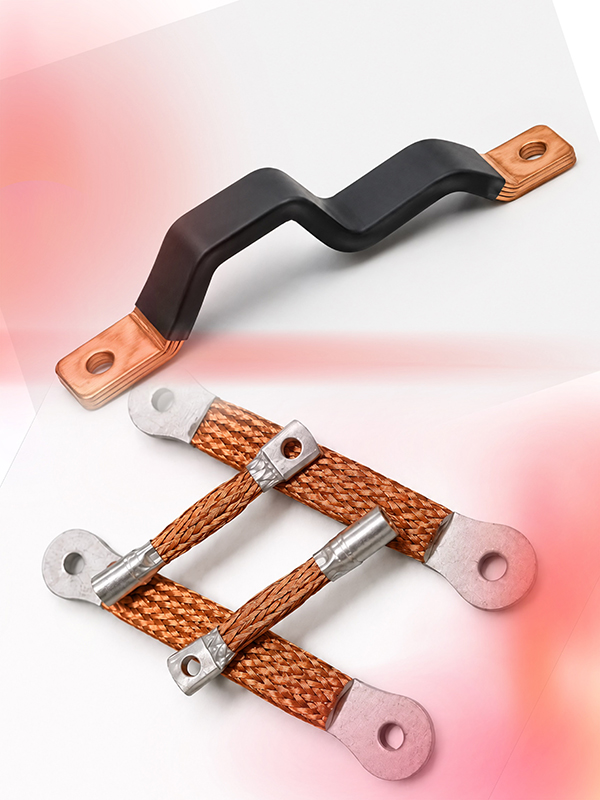
| Component Type | Functional Role | Design & Selection Principles |
|---|---|---|
| Copper Busbar | High-current main path | High conductivity; Sn/Ag-plating required to prevent oxidation. |
| Aluminum Busbar | Lightweight connection | Ideal for modules; requires Cu-Al transition plates and conductive paste to prevent galvanic corrosion. |
| Laminated Busbar | Internal PCS power path | Overlapping conductors cancel magnetic fields, reducing stray inductance and voltage spikes. |
| Grounding Jumper | Equipotential bonding | Braided structure utilizes "skin effect" to provide high vibration fatigue resistance. |
Beyond conductivity, thermal stability and mechanical creep are vital. Aluminum is prone to plastic deformation under high temperatures and constant pressure; thus, engineers must use washers to provide compensatory pressure during thermal cycling. Process controls—including the removal of stamping burrs and ensuring uniform plating thickness—are critical to long-term reliability.
The typical failure path is: Micro-loosening → Surface Oxidation → Increased Resistance → Joule Heating → Insulation Breakdown → Thermal Runaway. Modern designs utilize Finite Element Analysis (FEA) to simulate stress and implement preventive monitoring, such as infrared thermography.
Q1: Why choose aluminum busbars for cell connections?
Ans: Aluminum has a lower density and a thermal expansion coefficient similar to aluminum cell casings, reducing interfacial stress and system weight.
Q2: What is the advantage of Laminated Busbars?
Ans: They tightly stack conductors and insulation to reduce parasitic inductance, which suppresses voltage spikes in fast-switching devices like SiC, significantly enhancing PCS efficiency.
Q3: Why must grounding wires be braided?
Ans: A braided structure offers superior mechanical flexibility to absorb cabinet vibrations, preventing the metal fatigue fractures common in rigid wires.
Q4: How do you prevent galvanic corrosion in Cu-Al connections?
Ans: Direct contact between bare copper and aluminum is prohibited. Use molecular diffusion-welded Cu-Al transition plates and apply conductive anti-oxidation paste to seal the interface from air.
In modern BESS, busbars and grounding components are the cornerstone of system safety. As systems scale to 1500V and beyond, advanced interconnection technologies—laminated designs, flexible links, and smart monitoring—will define competitive advantage. By treating electrical connections as a primary discipline in reliability engineering, manufacturers can eliminate critical failure risks at the source.
Contact Avertronics to learn more about our Busbars and Grounding Jumper applications solutions.

