Data Center Power Grid Architecture: The Definitive Guide to Avertronics’ AIServerConnectivity Solutions
2026-03-20
Data Center Power Grid Architecture: The Definitive Guide to Avertronics’ AIServerConnectivity Solutions
Explore the future of AI power infrastructure. Learn how Avertronics integrates EPC engineering, 800V AC-to-DC conversion, HVDC distribution, and Anderson Power connectivity to power megawatt-scale AI GPU clusters from utility to rack.
Executive Summary: The AI Power Crisis and the Grid-to-Rack Revolution
The global transition toward Artificial Intelligence (AI) has fundamentally altered the physics of the data center. Traditional facilities, designed for standard CPU workloads, typically managed power densities of 5–15 kW per rack. However, the arrival of AI GPU clusters—such as NVIDIA’s Blackwell and Grace-Hopper series—has pushed these requirements to 50 kW, 100 kW, and even 150 kW per rack.
At these levels, traditional AC power distribution fails due to extreme heat, energy loss, and cable bulk. Avertronics provides the "Total Solution," combining professional EPC (Engineering, Procurement, and Construction) capabilities with high-performance connectivity to bridge the gap between the utility grid and the AI blade.
The Grid-to-Rack Power Architecture Revolution
From Traditional Low-Voltage to High-Voltage DC (HVDC)
Traditional data centers relied on Low-Voltage AC (208V–480V) to feed server PSUs. In the era of AI, this leads to:
High Current Losses: Extreme Amperage causes massive I²R (resistive) heat loss.
Copper Weight: Delivering 100 kW at low voltage requires cables too thick to manage.
Conversion Inefficiency: Multiple stages of AC to AC and AC to DC conversion waste up to 25% of total power.
The Revolution: Avertronics moves the AC-to-DC conversion upstream, delivering High-Voltage DC (±400V or 800V) directly to the rack. This reduces current by 10–20 times, slashes copper volume by 50–70%, and reduces total energy loss by 80%+.
Avertronics One-Stop Integrated Solution
Fragmented vendor models lead to "interface failure"—where connectors, PDUs, and UPS systems from different brands conflict. Avertronics offers a single-source integrated ecosystem:
One Engineering Framework: Coordinated protection and grounding.
One Procurement Strategy: Certified high-quality components.
One Commissioning Path: Factory-tested modular harnesses for rapid deployment.
AI Data Center Power Evolution: From Utility to Rack
The Modern Power Journey
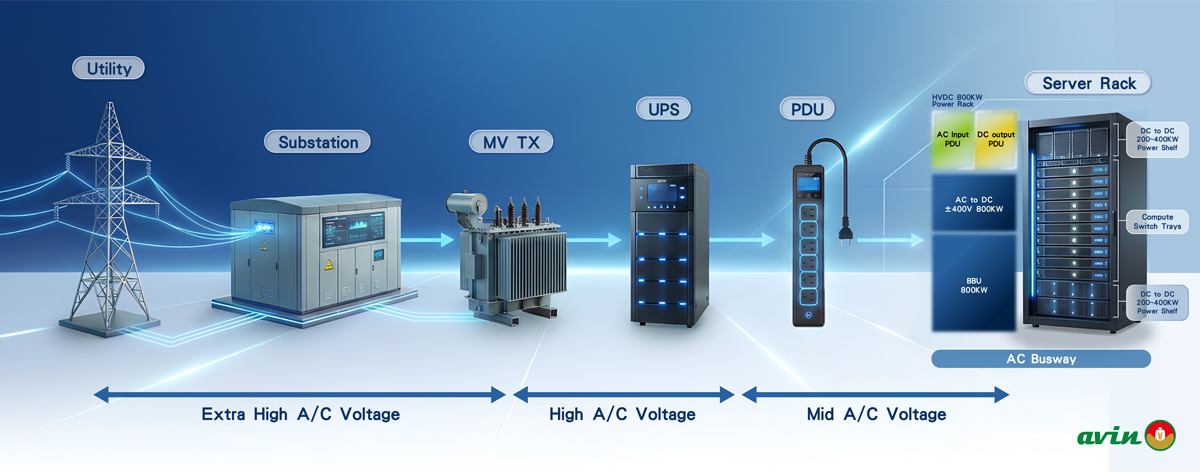
As shown in the architecture map, power flows through a multi-stage grid designed for high utilization:
Utility/Substation: Incoming Medium Voltage (13–27.6 kV).
Primary AC-to-HVDC Conversion: Centralized rectification managed by Avertronics EPC.
HVDC Distribution: Main DC busways carrying ±400V/800V.
UPS/BBU/BESS: Direct-to-DC battery backup for zero-latency failover.
PDU/Power Shelf: Final distribution via custom Avertronics harnesses.
AI Server/GPU Blade: High-transient loads (700W–1200W per GPU).
The Math of the 800V DC Advantage
Why is the industry moving toward 800V? It comes down to the physics of energy transmission. P = V X I (Power = Voltage × Current) Ploss = I2 X R (Power Loss = Current Squared × Resistance). If you need to deliver 1 MW (1,000,000 Watts) of power:
At 48V DC: Current (I) = 20,833 Amps
At 800V DC: Current (I) = 1,250 Amps
By increasing voltage, we reduce current by a factor of ≈16.6. Because loss is the square of the current, resistive energy loss is reduced by over 99%.
The Role of EPC Engineering in AI Infrastructure
Why EPC is Mandatory for Megawatt Racks
Avertronics doesn't just sell connectors; we provide Engineering, Procurement, and Construction. For AI clusters drawing megawatts of power, EPC ensures:
Load Flow Analysis: Calculating exact voltage drops to prevent GPU "throttling."
Harmonic Mitigation: Filtering out electrical noise generated by massive rectifier walls.
Grounding Architecture: Specialized equipotential grounding to prevent DC stray currents.
Thermal Validation: Infrared testing of every connection point under full load.
Anderson Power (APP) Connector Technology
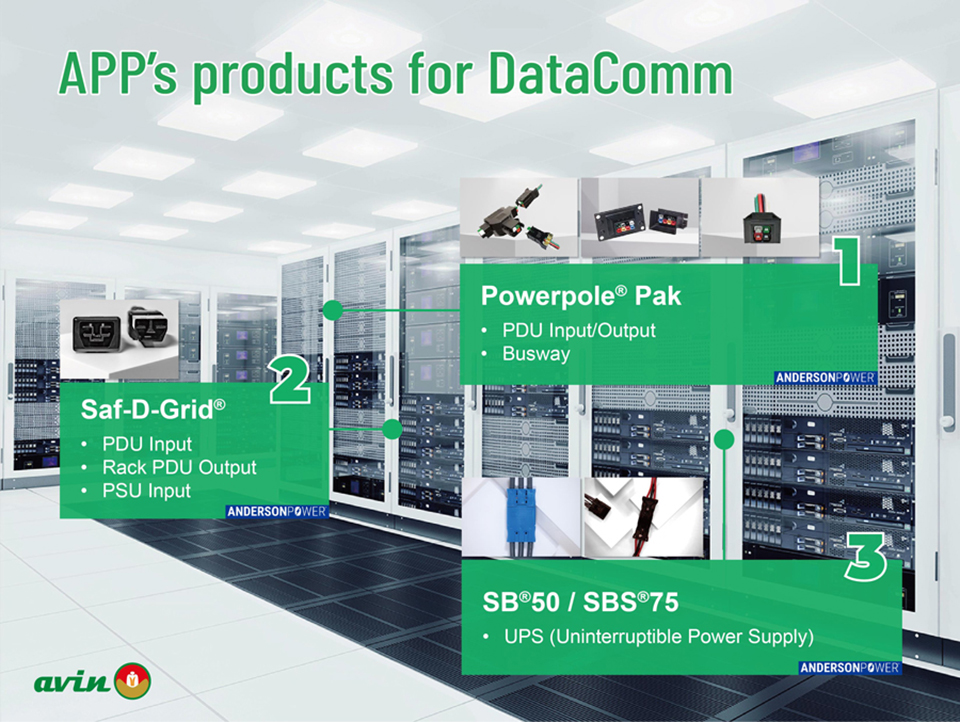
The "glue" of this architecture is the physical connector. Avertronics integrates Anderson Power to ensure zero-failure connectivity.
Saf-D-Grid: The Catalyst for HVDC
The Saf-D-Grid series is the global standard for DC distribution in the rack.
Voltage: Rated for up to 800V DC.
Density: Replaces bulky IEC plugs with a compact, high-current interface.
Safety: Arc-quenching design allows for safe hot-swapping under DC load.
SB Series & Powerpole for Backup Systems
SB Series: Heavy-duty connections (100–400A) for main battery banks and BESS.
Powerpole: Modular flexibility for internal BBU sensing and control lines.
UPS, BBU, and Hybrid Buffering Strategy
AI workloads are "bursty." A GPU cluster can ramp from idle to full power in microseconds.
The Three-Layer Backup Architecture
LIC (Lithium-Ion Capacitors): Handle millisecond-level transient spikes to stabilize voltage.
BBU (Battery Backup Unit): Direct DC-linked backup for second-to-minute level outages.
UPS/BESS: Facility-wide long-term energy storage.
By connecting these directly to the ±400V/800V DC Bus, Avertronics eliminates the need for DC to AC inverters, improving backup efficiency by an additional 8%.
Custom Wire Harnesses: The Critical Link
In an AI rack, space is at a premium. Avertronics manufactures Custom Wire Harnesses designed to:
Ensure Thermal Integrity: Factory-crimped connections that resist vibration and heat.
Speed Up Deployment: "Plug-and-play" modules that reduce on-site labor by 30–50%.
Comparative Analysis: Traditional vs. Grid-to-Rack
Feature
Traditional AC Architecture
Avertronics Grid-to-Rack (HVDC)
Conversion Topology
Distributed (Every server)
Centralized (Upstream)
Primary Voltage
208V–480V AC
±400V–800V DC
Energy Loss
20–25%
10–15%
PUE (Efficiency)
1.5–1.8
1.3–1.5
Deployment Risk
High (Multi-vendor fragmentation)
Low (Single-source EPC)
Case Study: The 800V Megawatt Cluster
Input: 480V AC Grid Feed.
Conversion: Centralized 800V DC Rectifier Wall using SB Series connectors.
Distribution: HVDC Busway using Saf-D-Grid terminations.
Buffer: Integrated BBU + LIC for transient smoothing.
Output: Seamless delivery of 1 MW to an NVIDIA Blackwell cluster.
Benefit: Savings of $10M+ in energy costs over the lifecycle compared to AC.
Sensata High-Performance Integrated Data Center Infrastructure Solutions
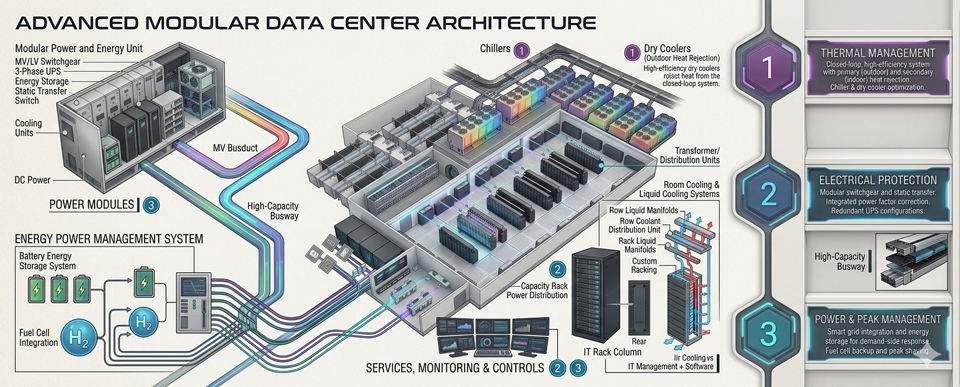
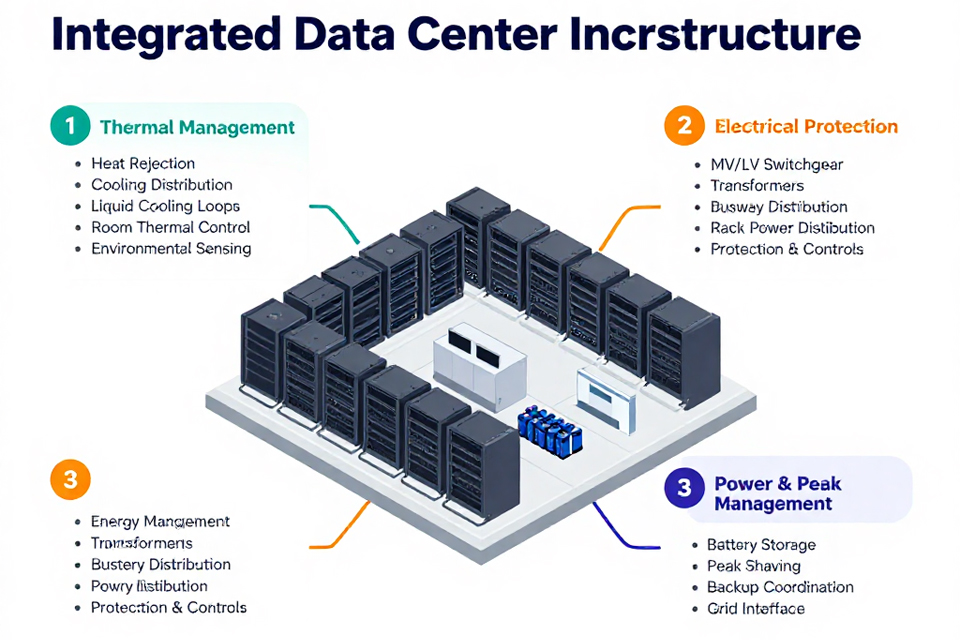
As the demand for AI and cloud computing continues to surge, building a stable, energy-efficient, and highly resilient Integrated Data Center Infrastructure has become a core operational priority. Sensata is committed to helping data centers optimize their critical operations through comprehensive sensing, electrical protection, and energy management technologies:
Intelligent Thermal Management Through precision sensing and control technologies, Sensata’s solutions encompass heat rejection systems and cooling distribution, including liquid cooling loops for high-density racks. Integrated with room thermal control and real-time environmental sensing, our technology ensures that equipment operates at optimal temperatures, significantly enhancing heat dissipation efficiency.
Reliable Electrical Protection A stable power supply is the lifeline of any data center. We provide robust, end-to-end hardware protection, from medium/low voltage switchgear and transformer units to high-capacity busway systems. Combined with precise rack power distribution and protection relays and controls, our solutions effectively prevent electrical faults to ensure uninterrupted server operations.
Energy Efficiency and Load Management Through Sensata’s energy management platform, operators can integrate battery storage for peak shaving and backup power coordination. Our grid interface technology not only helps reduce peak energy costs but also provides data centers with the energy flexibility required for long-term sustainability.
Leveraging industry-leading sensing technologies, Sensata empowers modern data centers to achieve smarter, safer, and more sustainable infrastructure operations.
FAQ
What is the definition of a "Grid-to-Rack" solution? It is an end-to-end power delivery system that manages everything from the utility substation interconnection to the final server-rack harness, optimized for high-efficiency DC power.
Why is 800V DC used for AI servers? It reduces current draw, which allows for thinner cables, lower heat generation, and significantly higher efficiency (up to 98%).
What role does EPC play in data centers? EPC (Engineering, Procurement, Construction) covers the total lifecycle of the power grid, ensuring the system is designed, sourced, and built to handle the extreme transients of AI loads.
Are Saf-D-Grid connectors hot-swappable? Yes. Unlike standard AC plugs, Saf-D-Grid is specifically engineered to safely break DC arcs during disconnection under load.
How does Avertronics reduce deployment time? Through modular, pre-tested custom harnesses and a turn-key integration model that eliminates the need for complex on-site wiring.
Conclusion: Powering the AI Revolution
Reliable AI computing begins with a rock-solid power foundation. The transition from legacy AC to integrated HVDC Grid-to-Rack architecture is no longer optional—it is a requirement for scalability. Avertronics is the only partner that combines:
End-to-End Design (EPC)
Advanced DC Conversion (800V)
Premier Connectivity (Anderson Power)
Custom Modular Harnessing
Ready to power the AI revolution? Partner with Avertronics for grid-to-rack excellence and Contact Avertronics today to optimize your grid-to-rack power architecture.