
Artificial Intelligence (AI) is revolutionizing the way data centers are designed and built. With the increasing demand for high-performance computing, AI racks are now consuming significantly more power than traditional enterprise racks. This surge in power consumption creates new challenges for data center operators, including delivering power to each AI rack without filling the room with thick cables, protecting every segment of the system from faults, and ensuring reliable physical connections over years of operation. In this article, we will explore how to address these challenges by combining Avertronics AI Server Connectivity Solutions and Sensata protection and control components.
Traditional enterprise racks were designed to handle a few kilowatts of mixed CPU workloads. However, modern AI racks hosting multiple high-end GPUs can draw ten times that power. Recent reference designs and white papers suggest that early GPU racks were around 10 kW per rack, while today's air-cooled AI racks often range from 20–40 kW per rack. Liquid-cooled AI racks and hyperscale deployments are pushing the limits even further, with design targets reaching 50 kW to over 100 kW per rack.
Key Statistics:
The classic model of large floor PDUs, long power cables to each rack, and basic rack PDUs is no longer sufficient for AI densities. Several problems arise, including cable congestion, voltage drop and losses, difficult changes, and higher fault energy. To avoid these issues, modern AI data centers are shifting to busway-based distribution and more sophisticated rack-level power and protection designs.
Challenges with Traditional Power Distribution:
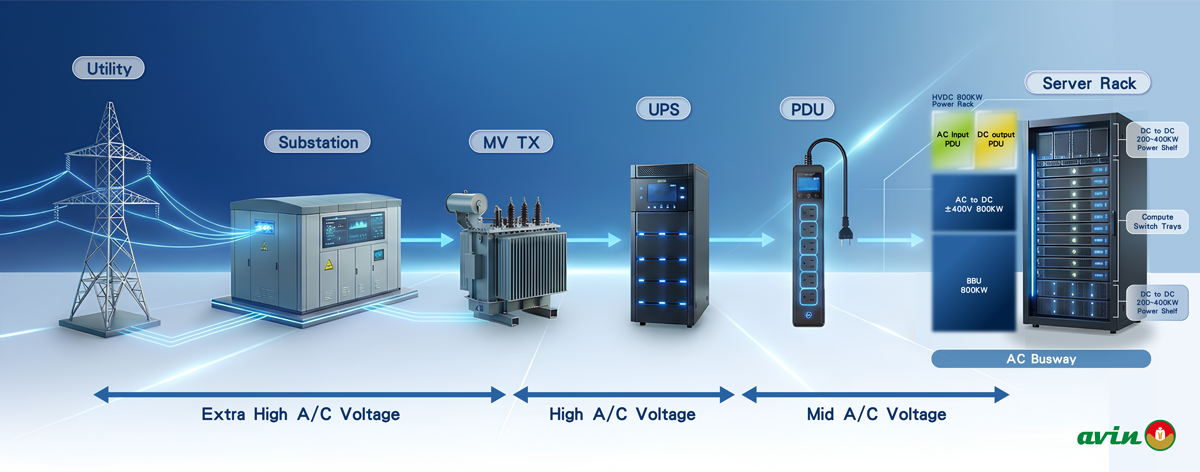
In a typical AI hall, power flows from the utility or on-site generation to medium voltage (MV) switchgear, which is then stepped down to low voltage (LV) distribution. The LV switchgear or room-level PDUs provide secondary distribution, and overhead busways run along the rows of racks. Tap-off boxes on each busway provide connection points for racks via short whip cables. Busways are preferred due to their ability to carry high current continuously, modularity, and reduced cable congestion.
Benefits of Busway-Based Distribution:
At each rack, the power flow continues through whip cables from tap-offs, which bring power into the rack. The rack may use one or more rack-mount PDUs on each side or power shelves that convert AC to a shared DC bus. Within the rack, vertical PDUs, busbars, or power shelves distribute power down to each server or GPU tray. Each AI server is usually dual-corded to ensure redundancy.
Rack-Level Power Distribution Components:
Avertronics Inc is a Taiwan-based manufacturer specializing in waterproof connectors and wire harnesses. Avertronics (AVIN) provides customized solutions for various industries "AIMES", including Automotive, Industrial, Mobility, Energy, and Server applications.
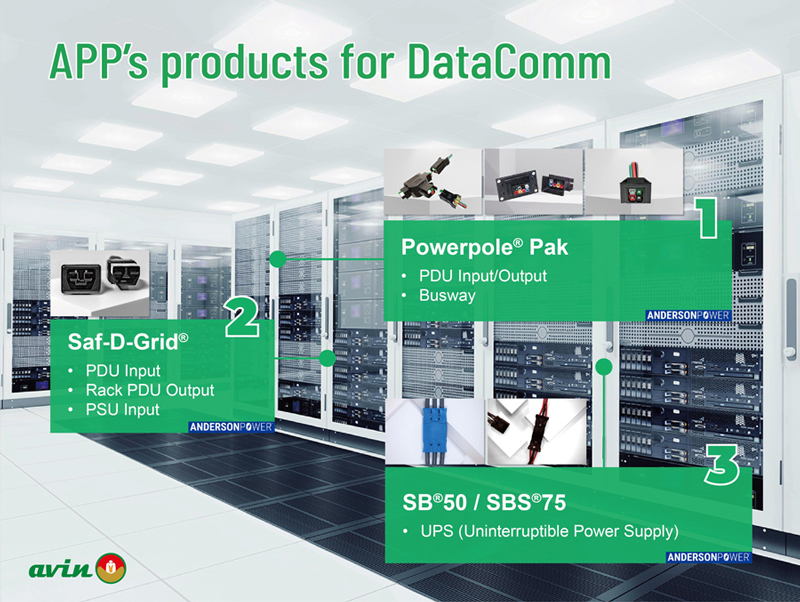
Avertronics' AI Server Connectivity Solutions are built around connectors and cables from Anderson Power (APP). Avertronics (AVIN) integrates APP SDG, SB series, and Powerpole series connectors into wire harnesses for AI servers, providing reliable, scalable, and safe connectivity.
APP Connectors Used:
Avertronics' experience in various industries, including automotive, industrial, and energy, has provided valuable insights into high-current and harsh environment wiring. This expertise makes Avertronics a suitable partner for rack internal and rack-adjacent power wiring.
Sensata Technologies is a global supplier of sensing, electrical protection, control, and power management solutions. Avertronics (AVIN)'s products are used in various applications, including automotive, industrial, aerospace, and data centers.
Sensata's AIRPAX hydraulic magnetic circuit breakers are widely used in power distribution units, UPS systems, and network equipment. These breakers offer accurate, temperature-independent trip curves, a wide current range, and various approvals.
Benefits of AIRPAX Circuit Breakers:
Sensata provides a range of products, including fuses, motor protectors, relays, and contactors, which are used to protect and control power distribution systems.
Sensata's sensors, including temperature and pressure sensors, float switches, and thermal switches/thermostats, help monitor and protect cooling loops, batteries, and power electronics.
Step 1 – Plan for Density, Redundancy, and Future Growth
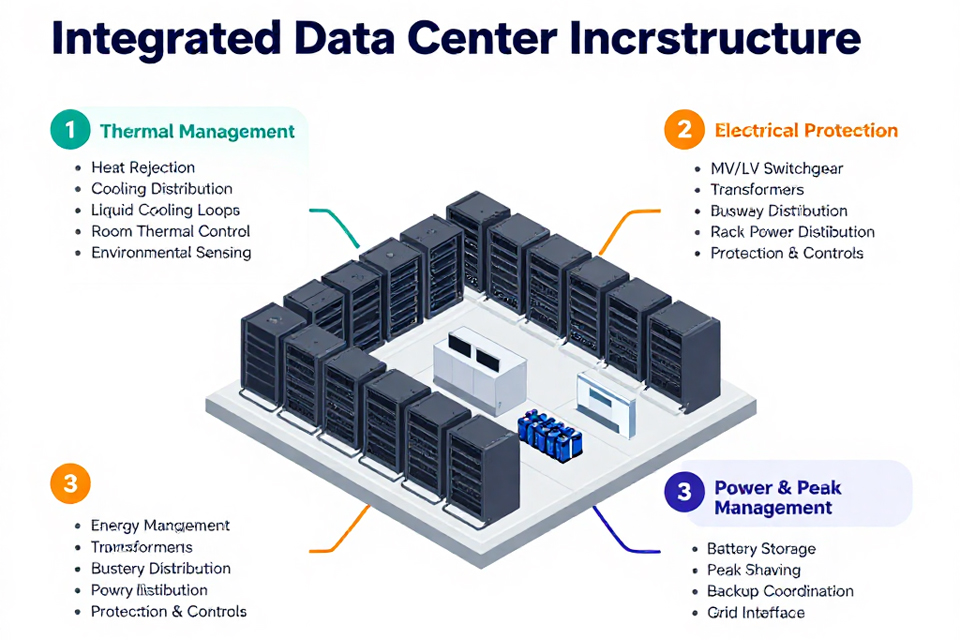
Data center operators should plan for higher density from day one, adopting busway-centric distribution and integrating protection at every level.
Step 2 – Choose Busway Centric Distribution for AI Rows
Overhead busways are the preferred choice for AI heavy rows, reducing cable congestion and improving scalability.
Step 3 – Design the Rack Power Spine
Inside each rack, Avertronics harnesses and APP connectors can be used to bring power into the rack, while Sensata protection and control components can be integrated to provide reliable and safe power distribution.
Step 4 – Connect to Servers and GPUs
Finally, at the server layer, Avertronics' experience in industrial harnesses can be applied to ensure reliable connectivity and power distribution.
Combining Avertronics and Sensata solutions provides a cleaner separation of roles, better reliability and maintainability, and easier standardization across regions.
Benefits of Combining Avertronics and Sensata:
To design a reliable and efficient AI rack power architecture, data center operators should:
By following these principles and combining Avertronics AIServerConnectivitySolutions with APP High Power Connectors+Power Cord, and Sensata protection+control components, data center operators can create a powerful, safe, and maintainable AI rack power architecture. Ready to power the AI revolution with safer design? Partner with Avertronics for grid-to-rack excellence and Contact Avertronics today to optimize your grid-to-rack power and safety management architecture.

